
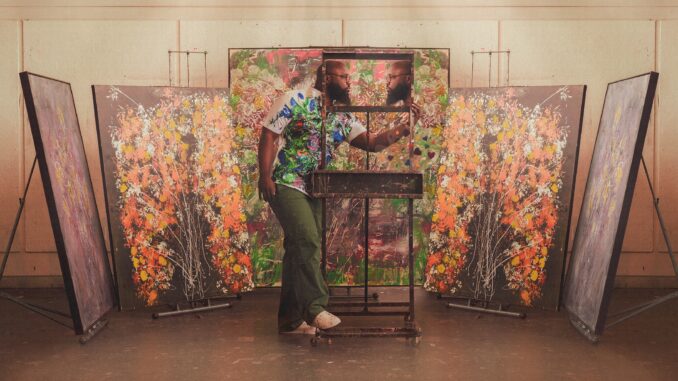
There’s something wonderfully old-school about HeART Museum.
Not “old” as in dated. Old-school as in 25 actual musicians in a room, horns and strings, big arrangements, real dynamics, and a singer who can actually sing the hell out of a song without hiding behind production tricks. That singer is Travis Hall, an Atlanta-based vocalist, songwriter and producer whose path to soul music took a rather unusual detour through opera.
Hall holds a Master of Music in Vocal Performance from Georgia State University and spent years performing with The Atlanta Opera, logging more than 200 shows through its educational touring program. Somewhere along the way, though, the music that originally moved him came calling again: Luther Vandross, Stevie Wonder, Donny Hathaway, Gladys Knight, Minnie Riperton and the rich tradition of Black American soul music.
The result is HeART Museum, an eight-song debut that sounds less like Hall abandoning his classical past and more like him finally figuring out what to do with all of it. And thank God he did.
The concept behind the album is simple and surprisingly effective: imagine your heart as a museum, with every relationship, memory and fleeting moment preserved like artwork hanging on its walls. Hall takes that idea seriously without becoming overly precious about it. These songs aren’t constantly announcing how emotional they are. Instead, feelings sneak up through photographs, seasons, smells, colors, fields of fireflies and all those tiny sensory details that somehow become permanently attached to people we once loved.
Musically, there is a lot happening here. Hall wrote, composed, arranged and produced all eight tracks, and you can hear the musical nerd in him coming out—in the best possible way. Jazz harmony, chromatic movement and sophisticated chord changes sit comfortably alongside lush strings, horns and an honest-to-goodness rhythm section. Yet HeART Museum never sounds like someone showing off what they learned in music school.
The technique serves the songs. “A Day,” remarkably the first song Hall ever wrote, is probably the clearest introduction to his musical brain. Inspired by everything from Chic to Donny Hathaway and Chaka Khan, it has the warmth and expansiveness of classic soul without slipping into imitation. Hall clearly studied the records he loves, but rather than photocopying them, he seems interested in figuring out why they worked in the first place.
That distinction matters. Then there’s “Fireflies,” which might be the album’s sweetest moment. Inspired by an actual night Hall spent walking through a firefly-filled field with a former partner, the track captures that almost embarrassingly tender stage of falling for someone when the entire universe suddenly seems to be cooperating with your romance. A real harp floats through the arrangement, and Hall wisely lets the song stay soft and dreamy rather than trying to turn every emotion into a vocal Olympics event.
For someone with serious classical chops, his restraint may actually be one of his greatest strengths. “Memories,” meanwhile, digs into something messier: the bizarre way a person can disappear from your life while remaining lodged in your senses. A photograph, a smell, a particular season—and suddenly they’re back. The arrangement mirrors that emotional escalation, beginning sparsely before gradually opening into something richer and heavier. Jazz-informed harmonic movement gives the song an unsettled quality that fits its subject perfectly.
And yes, Hall’s voice is the obvious centerpiece. He’s a leggiero tenor, but you don’t need to know what that means to appreciate the instrument. There’s an ease and clarity to his upper register, along with the control you’d expect from someone who spent years studying classical technique. More importantly, he knows when not to use all of it.
Plenty of technically gifted singers spend entire albums reminding us that they’re technically gifted singers. Hall seems more interested in telling the story. That may be where HeART Museum succeeds most.
The album isn’t fascinating simply because “opera singer makes R&B” is a fun headline. It’s fascinating because you can actually hear those worlds interacting. Classical training shows up in Hall’s phrasing and dynamics. Jazz appears in his harmonic choices. Soul gives the record its emotional center. And his songwriting keeps all of that musical sophistication connected to something recognizably human.
There are some serious collaborators behind the scenes, too. GRAMMY-winning engineer Brent Kolatalo, whose credits include Kanye West and Bruno Mars, worked alongside Hall on the project, while Fili Filizzola handled mastering. But this remains unmistakably Hall’s baby: he wrote, composed, arranged and produced the entire thing and retains ownership of the project.
For a debut, that’s an impressive amount of artistic control. Apparently listeners have noticed. Hall has already sold out Atlanta’s Vinyl at Center Stage with a 16-piece ensemble, appeared as an official Atlanta Jazz Festival Partnership Artist, landed “Kiss Goodnight” on TIDAL’s Future Soul editorial playlist and earned international attention after Fresh On The Net selected “A Day” as its Track of the Week. The “Fireflies” video has picked up festival recognition of its own, including a Best Music Video win at the Urban Media Makers Film Festival.
“A Day” and “Fireflies” were also entered for consideration across four categories for the 68th Annual GRAMMY Awards. They didn’t ultimately become nominees, but for an independent artist’s first body of recorded work, reaching that stage of the process feels like an appropriate introduction to where Hall is heading.
Now a Recording Academy Voting Member in the Class of 2026, Hall has arrived at an interesting crossroads. He has the conservatory education, the opera experience, the jazz vocabulary and the kind of voice capable of doing flashy things.
But HeART Museum suggests he’s figured out that the flashy stuff isn’t really the point.
The point is the field of fireflies.
The photograph you probably shouldn’t have looked at again.
The smell that suddenly reminds you of somebody.
The strange little exhibits we collect inside ourselves long after the people and places attached to them have disappeared.
Hall simply built a museum for his.
And it’s well worth wandering through.
Listen on Spotify Here
Leave a Reply